 Related Products
Flexitanks vs Drums for Edible Oil Export: Cost, Capacity and Contamination Compared
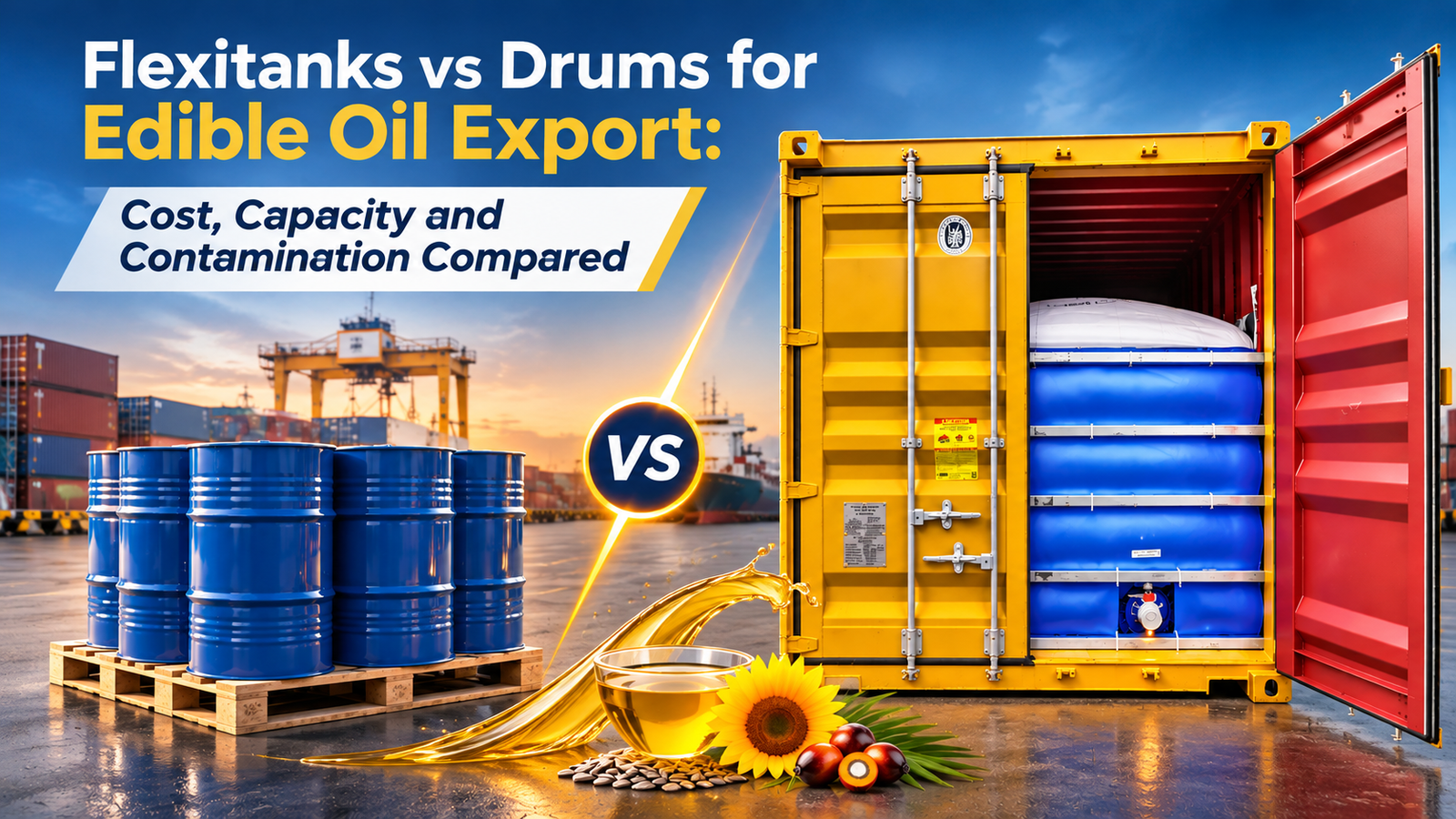
For Indian edible oil exporters and re-exporters, the packaging format chosen for each container shipment determines the landed cost per tonne more than almost any other logistics variable. A 20-foot container loaded with 80 steel drums carries roughly 16,000 litres. The same container fitted with a single flexitank carries up to 24,000 litres. That is up to 50% more product per sailing, at a fraction of the packaging cost.
This comparison breaks down the numbers that matter for exporters choosing between flexitanks and drums: packaging cost per shipment, freight cost per metric tonne, contamination risk for food-grade cargo, and the operational trade-offs that determine which option fits which route.
Key Takeaways
- A flexitank carries up to 24,000 litres per 20ft container versus 16,000 litres in drums, up to a 50% payload advantage that reduces the number of containers per contract by roughly one-third.
- Packaging cost drops by 85-92% per shipment: a single bladder at INR 15,000-21,000 replaces 80 drums costing INR 1.7-2.7 lakh plus filling labour, pallets and return logistics. (Tentative — flagged for Amfico team verification.)- check with Tanveer
- Single-use, food-grade PE/PP construction certified under COA, FDA, HACCP, KOSHER, HALAL and FSSC 22000 eliminates the cross-contamination risk that reused drums carry.
- Drums still make sense for split consignments below 10,000 litres, hazardous cargo and very high-frequency reusable routes where an ISO tank container is more economical.
- Amfico provides flexitank solutions through Infinity Bulk Logistics (Malaysia) with on-site installation, marine insurance up to INR 42 crore and full logistics coordination from the ALL HUB facility near Nhava Sheva.
Why Packaging Choice Changes Your Landed Cost per Tonne
Landed cost is the total expense of delivering one metric tonne of edible oil from the filling plant to the buyer’s discharge point. It includes raw material cost, packaging, inland transport, ocean freight, port handling, insurance and import duties.
Packaging and freight together account for 8-15% of the landed cost on most India-to-destination routes. Of that, the packaging format itself drives two variables that exporters can control directly: how much product fits inside each container (payload efficiency) and how much the packaging materials cost per shipment (material cost).
Drums split the payload across 80 individual vessels, each requiring procurement, filling, palletising, loading and strapping. A flexitank consolidates the entire load into a single liner. The cost difference compounds across every shipment in a contract, and across every route in an export programme.
What Is a Flexitank and How Does It Work?
A flexitank is a single-use, collapsible bladder made from multi-layer food-grade polyethylene and polypropylene. It is fitted inside a standard 20-foot dry shipping container, converting the box into a bulk liquid vessel capable of holding 16,000 to 24,000 litres of non-hazardous liquid cargo.
The installation process takes approximately 20-30 minutes. A protective liner is placed on the container floor, the bladder is unfolded and positioned, a bulkhead is fitted at the container doors to brace the bladder during transit, and the fill valve is connected to the pump line. Loading is completed through a top or bottom valve, depending on the cargo type and discharge requirements at destination.
After discharge, the unit is disposed of. There is no return freight, no cleaning cycle and no risk of residual contamination from a previous cargo.
Flexitanks supplied through Amfico are manufactured by Infinity Bulk Logistics (Malaysia) and carry COA, FDA, HACCP, KOSHER, HALAL and FSSC 22000 certifications. The multi-layer PE/PP construction is rated for a temperature range of -20 degrees C to +70 degrees C, with optional thermal insulation liners available for temperature-sensitive oils.
How Flexitanks Compare with Drums on Cost
Packaging Material Cost per Shipment
The packaging cost difference between drums and flexitanks is where the savings start.
|
Cost Component |
Drums (80 x 200L) |
Flexitank (24,000L) |
|
Packaging material |
Tentative: INR 1.7-2.7 lakh per container |
Tentative: INR 15,000-21,000 per bladder |
|
Filling labour |
4-6 workers, 3-4 hours |
1-2 workers, 45-60 minutes |
|
Pallets and strapping |
INR 12,500-25,000 |
Not required |
|
Return/disposal of empties |
INR 17,000-42,000 per shipment |
Not applicable (single-use) |
Note: Cost figures are indicative, based on industry benchmarks for India-origin shipments. Actual pricing varies by supplier, route and volume. Flagged for Amfico team verification before publishing.
The packaging material alone represents an 85-92% cost reduction per container when switching from drums to a single liner. When filling labour, pallet costs and empty drum logistics are factored in, the total packaging-related saving per shipment ranges from INR 1.7 lakh to INR 2.9 lakh.
Freight Cost per Metric Tonne
Ocean freight is charged per container, not per litre. A 20-foot container costs the same to ship whether it carries 16,000 litres in drums or 24,000 litres in a flexitank.
This means the freight cost per metric tonne drops by roughly 33% with this option, because the same fixed container rate is spread across 40% more cargo.
For an exporter shipping 50 containers per year, the freight saving alone (at typical India-to-Middle East or India-to-Africa rates) adds up to the equivalent of 15-20 additional containers’ worth of product moved at no extra ocean freight cost.
Landed Cost Comparison
|
Metric |
Drums |
Flexitank |
Advantage |
|
Payload per 20ft container |
~16,000 litres |
Up to 24,000 litres |
Flexitank: up to +50% |
|
Packaging cost per shipment |
Tentative: INR 2.1-3.4 lakh (all-in) |
Tentative: INR 21,000-34,000 (all-in) |
Flexitank: 85-90% lower |
|
Freight cost per MT |
Higher (fewer MT per container) |
Lower (more MT per container) |
Flexitank: ~33% lower |
|
Containers needed for 1,000 MT |
~68 containers |
~46 containers |
Flexitank: 33% fewer sailings |
All cost figures are tentative and require verification by the Amfico operations team before publication.
Capacity Advantage: Up to 50% More Oil per Container
A standard 20-foot container has an internal volume of approximately 33 cubic metres. Drums use this space inefficiently because of their cylindrical shape, the gaps between drums, and the pallets and dunnage required to secure them.
Eighty 200-litre steel drums occupy the full container but carry only 16,000 litres of product. The remaining volume is dead space between drum walls, structural bracing and pallet boards.
The liner, by contrast, fills the rectangular container cavity as a single conforming bladder. The usable payload reaches 24,000 litres on most configurations, with some high-capacity units stretching to 24,500 litres depending on the container’s internal dimensions and the cargo’s specific gravity.
For edible oil exporters, this capacity advantage translates directly into fewer containers per contract, fewer bookings per quarter and lower total logistics cost per tonne shipped.
Example: An exporter with a 5,000 MT annual sunflower oil contract (specific gravity ~0.92, so 1 MT = ~1,087 litres) would need approximately 340 drum-loaded containers at 16,000 litres each. With flexitanks at 24,000 litres each, the same tonnage moves in approximately 227 containers. That is 113 fewer container bookings per year, 113 fewer sets of documentation and 113 fewer loading and discharge operations.
Contamination Risk: Why Single-Use Wins for Food-Grade Oils
The Cross-Contamination Problem with Reused Drums
Steel and HDPE drums are designed for multiple uses. Between shipments, they require cleaning, inspection and recertification. In practice, cleaning standards vary widely across drum reconditioning facilities, particularly in price-sensitive supply chains.
Residual traces of previous cargo (chemicals, non-food-grade oils, industrial lubricants) can remain in drum seams, welds and under gasket rings even after standard cleaning procedures. For food-grade edible oil shipments governed by FSSAI (India), FDA (US) or EU food contact regulations, any trace contamination risks cargo rejection at destination, buyer claims and potential regulatory action.
The problem multiplies with scale. Eighty drums per container means 80 individual contamination risk points, 80 gaskets, 80 closures and 80 surfaces that must each meet food-contact standards.
How Flexitanks Eliminate Contamination Risk
Each unit is manufactured, used once and disposed of. There is no previous cargo history, no cleaning cycle and no reconditioning step.
The multi-layer food-grade PE/PP construction meets COA, FDA, HACCP, KOSHER, HALAL and FSSC 22000 certification requirements. Each unit arrives factory-sealed at the loading site.
For edible oil buyers, particularly in markets with strict import food safety standards (Middle East, EU, East Africa), the single-use certification trail provides documentation that reused drums cannot match. The buyer receives a shipment with a clean chain of custody from manufacture to fill to discharge, with no intermediate handling history to audit.
Which Edible Oils Work Best in Flexitanks?
Sunflower Oil and Soybean Oil
These are the highest-volume edible oils shipped in flexitanks globally. Both have low viscosity at ambient temperatures, pour easily during loading and discharge, and are chemically stable in contact with food-grade PE/PP liners. Sunflower and soybean oil exports from India, Ukraine and Argentina routinely move in 24,000-litre flexitank configurations.
Palm Oil and Coconut Oil
Palm oil and coconut oil solidify or become highly viscous below 25-30 degrees C. Bulk liner shipments of these oils require thermal insulation liners or heating pads to maintain pourability during transit and at discharge.
Units supplied through Amfico include optional thermal insulation liners and heating pad accessories rated for the -20 degrees C to +70 degrees C operating range. For palm oil shipments to cooler-climate destinations, the insulation liner is a standard add-on rather than a custom request.
Specialty and Organic Oils
Olive oil, sesame oil, rice bran oil and organic-certified variants benefit most from the single-use contamination guarantee. These higher-value oils carry tighter food safety requirements and higher per-litre costs, making any contamination event disproportionately expensive.
The KOSHER and HALAL certifications on these units are particularly relevant for specialty oil shipments to Middle Eastern and Southeast Asian markets where certification documentation is a mandatory import requirement.
When Drums or ISO Tanks Still Make Sense
Flexitanks are not the right choice for every liquid cargo shipment. Two scenarios favour alternatives.
Small or split consignments. When the shipment volume is below 10,000 litres, or the order requires delivery to multiple buyers from a single container, drums allow split distribution without decanting. This option is a single-vessel, single-consignee solution.
Hazardous cargo. Flexitanks are approved for non-hazardous liquids only. Flammable chemicals, corrosive substances and Class 3 or higher dangerous goods require ISO tank containers or UN-rated drums with appropriate hazmat certification.
Reusable high-frequency routes. For exporters running the same route weekly with the same cargo, an ISO tank container (which Amfico also manages as part of its liquid logistics operations from the ALL HUB facility in Mumbai) can be more economical over a 5-year asset life, despite the higher per-unit cost.
How Amfico Supports Flexitank Shipments from India
Amfico provides flexitank solutions as part of its liquid logistics operations from the ALL HUB facility in Uran, near Nhava Sheva (JNPT). The ALL HUB is India’s first fully integrated liquid logistics facility, handling flexitank fitting, ISO tank operations, warehousing and port-proximate staging under one roof.
[Video available — MP co team to embed: Flexitank installation/loading process at ALL HUB facility]
For flexitank shipments, Amfico handles:
- Flexitank supply through Infinity Bulk Logistics (Malaysia), with COA, FDA, HACCP, KOSHER, HALAL and FSSC 22000 certified units
- On-site fitting and installation at Indian ports and client plants
- Thermal insulation liners, heating pads, anti-bulging systems and custom valve configurations as optional accessories
- Logistics coordination from filling plant to port
- Marine insurance coverage up to INR 42 crore per shipment
- Documentation support for food-grade export compliance
The proximity of ALL HUB to Nhava Sheva (India’s largest container port for liquid cargo exports) reduces inland transport time and allows same-day container staging for vessels berthing at JNPT.
For exporters currently shipping in drums and evaluating the switch to flexitanks, Amfico’s operations team can run a route-specific cost comparison based on actual freight rates, cargo volumes and destination port requirements.